AMZTool/Blog/Buy Box Guide

Strategy Guide

Cracking the Amazon Buy Box Code

The ultimate guide to winning the Buy Box and exploding your sales. Master the algorithm, debunk the myths, and implement winning strategies.

Also available in: 中文版

William
William
12 min read·Published: April 8, 2026
Share:
82%
of purchases via Buy Box
<1%
ODR target
10
Ranking factors

I've spent two years analyzing Buy Box performance across dozens of products. The single biggest lesson: where your product appears on Amazon determines everything. If shoppers can't find you easily, they can't buy from you. And to secure the best visibility, you must master one specific element: The Buy Box.

Winning the Buy Box isn't just a vanity metric; it is the fundamental engine driving sales. In my own experience, products that hold the Buy Box consistently see 3-5x more orders than the same products when they lose it. Industry data backs this up — roughly 82% of all Amazon purchases go through the Buy Box, and the percentage is even higher on mobile.

What Exactly Is the Amazon Buy Box?

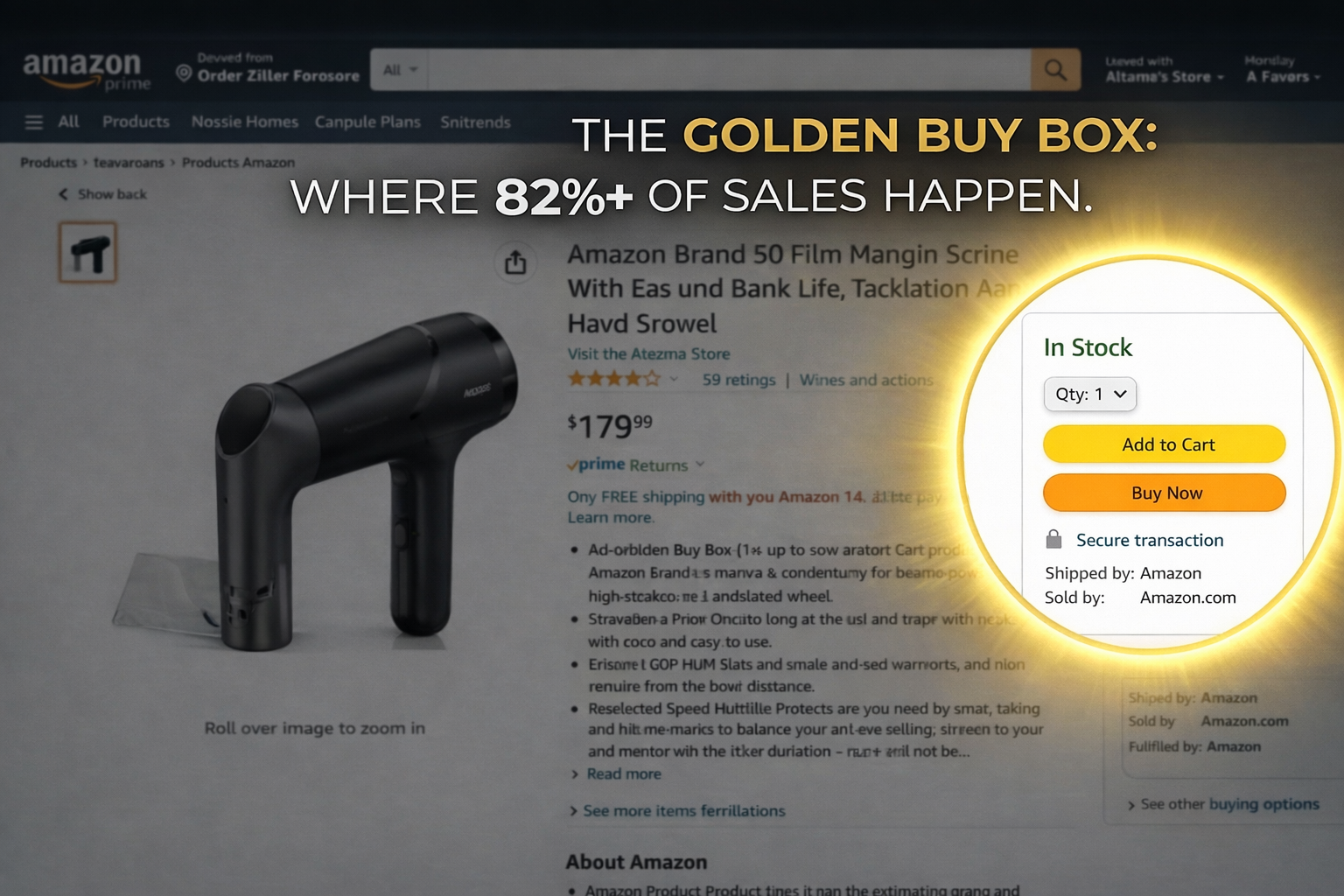
The Amazon "Buy Box" is the dedicated section of a product listing page where customers find the "Add to Cart" and "Buy Now" buttons.

When a customer finds a product and decides to make a purchase, this is almost always where they look. If a buyer adds the product to their cart without manually selecting a specific seller, the seller who currently "holds" the Buy Box gets the sale.

💡
Roughly 80% of all Amazon sales are funneled through the Buy Box. Possessing the Box can significantly boost an item's visibility, frequently helping it land on highly coveted lists like the Amazon top selling products.
Amazon Buy Box example showing Add to Cart and Buy Now buttons on a product listing

The Buy Box — where "Add to Cart" and "Buy Now" live

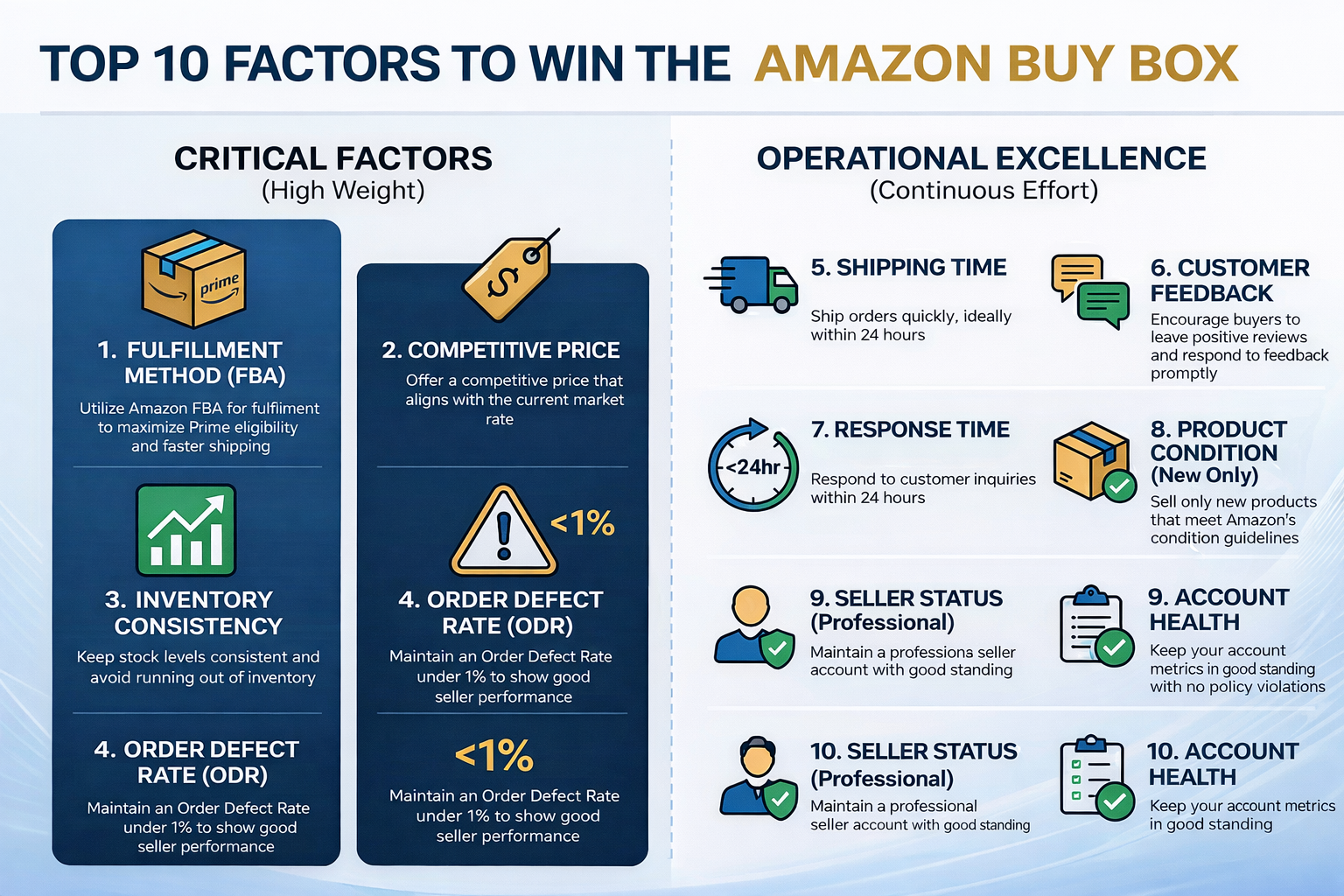
Decoding the Buy Box Algorithm: 10 Critical Factors

Amazon Buy Box algorithm factors and seller performance metrics

The Buy Box operates 24/7, tireless and dynamic. Amazon's complex formula continuously analyzes hundreds of data points to evaluate which seller is most likely to provide the best customer experience.

#FactorWhat Amazon Looks For
1Seller StatusMust have a Professional Seller account (monthly fee applies)
2Product ConditionOnly new products are eligible for the main Buy Box
3Performance MetricsRefund rates, cancellation rates, and customer service history
4Inventory StatusOut of stock = instant loss of eligibility
5Stock ConsistencyFrequent stockouts severely hamper your ability to win
6Product PriceCompetitive pricing including shipping, tax, and handling
7FulfillmentFBA is widely preferred by the algorithm
8Shipping TimesFast and reliable delivery; slow shipping is heavily penalized
9Order Defect RateMust stay below 1% threshold
10Customer FeedbackRecent positive reviews (30, 90, and 365 day windows)

Buy Box Eligibility vs. Winning the Box

There is an important difference between being "Eligible" and actually winning.

Buy Box Eligibility refers to whether your account meets the minimum performance standards required by Amazon to compete for the Box. To become eligible, you must have an Amazon Professional seller account and meet baseline requirements (e.g., low ODR, competitive pricing, fast shipping, 24/7 customer service).

ℹ️
While eligibility itself does not carry an extra fee, you must continuously maintain these high standards over time to stay in the running. Eligibility is the entry ticket — winning requires ongoing excellence.

Understanding Critical Buy Box Metrics

If you utilize Seller Fulfilled Prime (SFP) or Fulfillment by Merchant (FBM), you must be even more meticulous. FBA sellers have many critical metrics automated by Amazon, but for SFP and FBM sellers, these targets are essential:

Core Performance Targets

MetricTarget
Order Defect Rate (ODR)< 1%
Late Shipment Rate< 4%
Pre-Fulfillment Cancel Rate< 2.5%
Valid Tracking Rate> 95%
On-Time Delivery Rate> 97%

Customer Service Metrics

MetricTarget
Response Time90%+ of responses under 24 hours
Average Response TimeMust minimize this average
Buyer-Seller Contact< 25% of contacts related to issues
💡
Quick shipping often costs more, which directly impacts price competitiveness. Achieving balance across all performance areas is the goal. Monitor your standing in the "Account Health" section of Seller Central.

Debunking Common Buy Box Myths

Numerous articles claim to have "hacked" the Buy Box algorithm. These often rely on oversimplified or outdated tips that can damage your account. Let's clear up the most common myths:

Myth 1: Lowering the price by one penny always wins.

This theory states that if you just undercut the lowest-priced competitor by a specific percentage, and then subtract an extra cent, you are guaranteed to win.

❌ Not true.

This myth gained traction because low-priced items often see high turnover, resulting in numerous false positives. Strategic pricing does matter, but there is no magic, one-size-fits-all formula. The algorithm considers value, speed, and history, not just the lowest raw number.

Myth 2: If you are within 2% of the winner, you always get a share of rotation.

This misconception claims that any seller whose price is within a strict threshold (like 2%) of the current Box holder is 100% guaranteed a minimum percentage of Box rotation time.

❌ Unsupported by evidence.

While you may see false positives when testing, this theory should not be relied upon. The algorithm is far more complex than simple raw price proximity. Buy Box rotations do exist, but they are not governed by simplistic price rules.

Smart Pricing Strategies for Buy Box Domination

To increase your chances of winning the Buy Box, you must price strategically. Your volume of sales will dictate which method is most effective.

1. Manual Pricing

You manually adjust your product price to win the Box. This can be effective for listings with low competition or only a few SKUs, but it is highly time-consuming and challenging for high-volume sellers.

2. Rule-Based Pricing

A straightforward process where you set specific rules for automated adjustments (e.g., "Always stay $0.05 lower than the lowest-priced FBA competitor"). While efficient, this method can easily trigger a "race to the bottom", starting a pricing war that ultimately destroys profit margins.

3. Algorithmic Pricing

This is the gold standard. Algorithmic repricers use machine learning to analyze hundreds of variables in real-time — including current pricing, Amazon metrics, competitor behavior, and profitability data. They find the perfect price to maximize profitability, striking the optimal balance between winning the Box and generating the highest profit per sale.

The Bottom Line

The Amazon Buy Box is one of the most valuable assets in the e-commerce landscape. Winning it is incredibly competitive, but the rewards are massive: a surge in traffic, increased revenue, and long-term business health.

Earning the Box should always be your goal. If you don't have it today, use these strategies to relentlessly improve your performance. With the right strategy and consistent operational excellence, you can take it.

Related reads: Best Amazon PPC Tools 2026 · Bulk Sheet Tools Compared · Bulk Upload Tutorial

🚀
Ready to scale your Amazon campaigns? Use AMZTool to generate bulk sheet files for Sponsored Products in seconds — build keyword, ASIN, and auto targeting campaigns visually, then upload directly to Amazon Ads.

Win the Buy Box. Start Selling More.

Generate Amazon Sponsored Products bulk sheets in seconds — free to start.

Read more: Bulk Sheet Guide · Upload Tutorial

Get Started Free
William
William

Amazon PPC practitioner turned indie developer. I built AMZTool because I got tired of spending hours on repetitive campaign setup. When I'm not coding, I'm probably staring at ACOS numbers.

Published in:AdvertisingStrategyPPC
Share:

© 2026 AMZTool · Guide · Pricing · Blog · Privacy